As AI looms large, we should remember that craft (human craft) signals care and competence, which are qualities that cannot be emulated.
During a person’s lifetime, their heart will beat 3bn times. If you, as a brand, are trying to get someone’s attention and their consideration, offer real value. Make the number of heartbeats you’re taking up mean something.
In 1969, the Seiko Astron was launched. It was the world’s first watch that kept time using an electronic oscillator regulated by a quartz crystal. Not only was it more accurate, it was cheaper.
Many traditional watchmakers failed to defend why mechanical watches cost more. Those watchmakers that didn’t disappear within a few years learned to adapt.
 But how could they compete? Their solution was complications – a horological term for additional features – and craft.
The parallels with AI and its threat to creatives everywhere are obvious. What can we offer as added value to our clients (and the wider world)? Craft? Well, yes, that and more.
The onus is on us to work this out. What capabilities that go beyond our core functions can we provide?
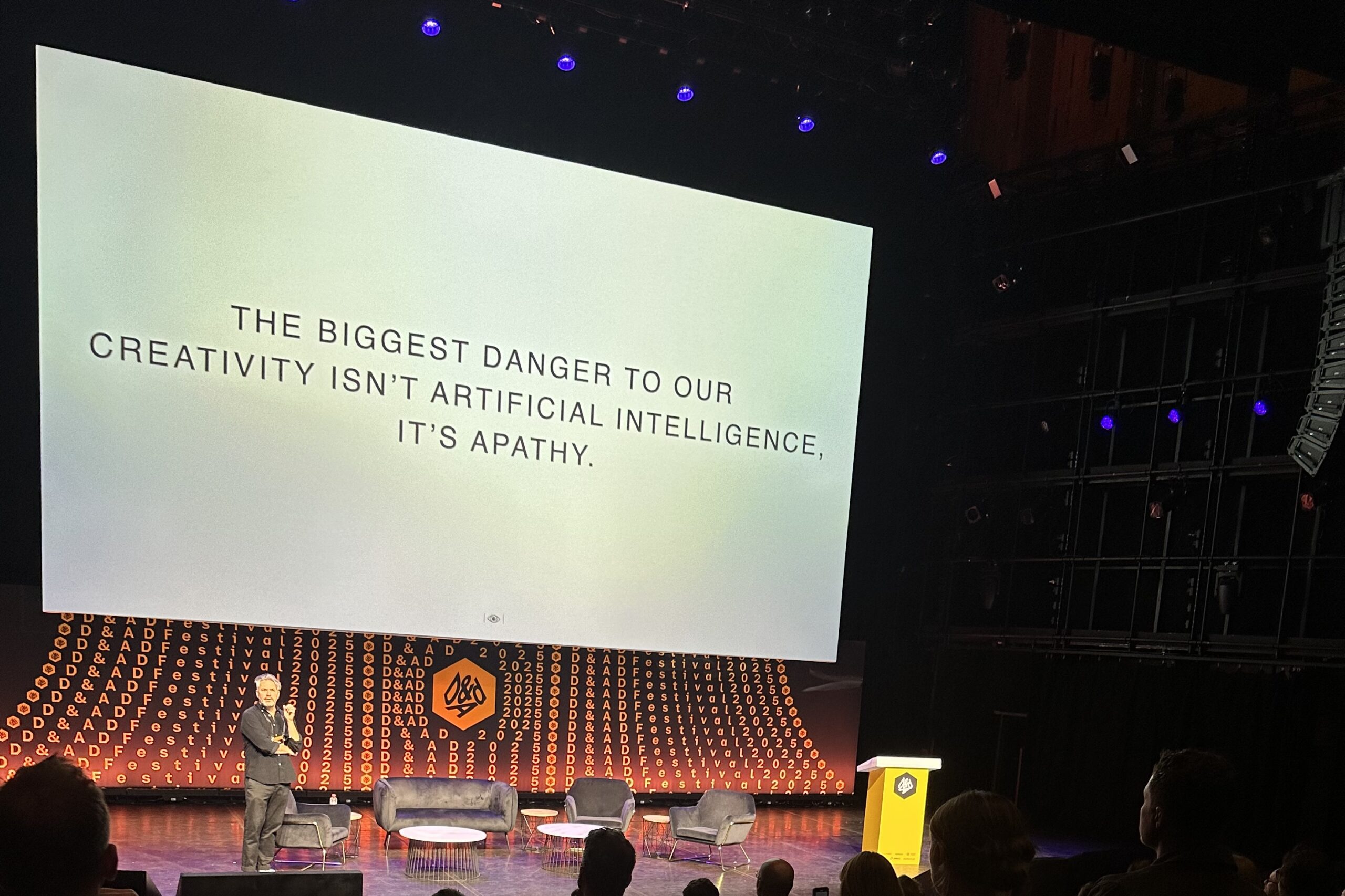
As Nils Leonard put up on the screen behind him in big sans serif type: “The biggest danger to our creativity isn’t artificial intelligence, it’s apathy.”
And there is hope. (There must be!) The Open AI brand refresh was presented to us. The work was all done… by creatives, by real live human beings. And what lovely work – crafted, thoughtful, warm, aesthetically satisfying. It has heart and soul, and you can really feel it.
All of this (and more) I gleaned from these brilliant presentations:
- The Psychology Behind Craft by Ben Langsfeld, Teo Connor and Dr Paul Marsden
- Perform or Perish by Leland Maschmeyer
- Precipice by Nils Leonard
- Behind the Scenes of OpenAI’s Brand Identity Refresh by Shannon Jagerand Liza Enebeis